When Rey's repaired lightsaber appeared in the first Rise of Skywalker trailer, I honestly wasn't that interested. After what happened to the lightsaber in The Last Jedi, part of me hoped we'd get to see it replaced with something brand new in the sequel. When I went to see the movie, however, something in my brain switched and I just had to have this lightsaber! As soon as I got home I started shopping for all of the materials I'd need.
This is by no means my first lightsaber build; back in 2017, my dad and I made a replica of Luke's lightsaber from A New Hope using aluminium. I'd never worked with metal before so he taught me a lot of new techniques that I can't wait to practice and perfect with Rey's lightsaber!
Normally I don't care about using accurate materials - if something is meant to be metal, I just paint it silver, y'know? - but when it comes to lightsabers, I want them to look and feel as authentic as possible. I guess it must have something to do with how iconic these props have become, and with so much history and lore behind them (both in-universe and in real life) I want to do them justice by making my replicas look as good as possible. And so without further ado, it's time to start building!!
(But not before this important safety message: when working with metals in any capacity, I always work outside - wearing a dust mask and goggles to protect my lungs and eyes from the metal dust/filings. I also lay down a sheet to make it easier to clean up when I'm finished for the day.)


I decided to start with the trickiest part of the project: cutting out the S-shaped emitter shroud. To help me, I printed out this template and taped it around my aluminium tube.
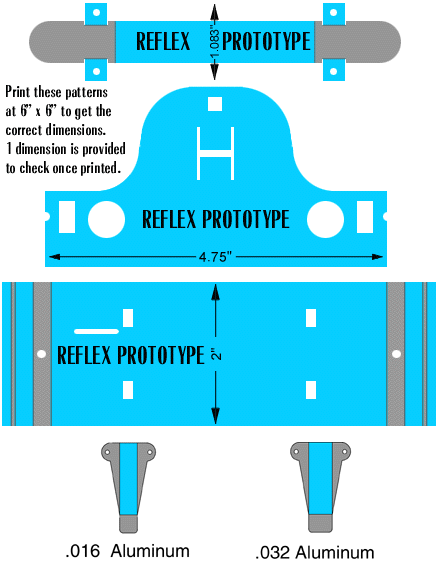

I then used my hacksaw to cut out the rough shape of the emitter, before filing the metal all the way back to the template. This took a very long time, but it was super important to be patient and make this as neat as possible!


For the large holes that sit below the emitter, I had to drill a small pilot - not deep enough to go all the way through the tube, but deep enough to act as a guide for the larger bit to minimise the risk of it slipping and ruining the whole thing (I did not want to have to redo the emitter!😂)
The holes needed to have a diameter of 13mm, and I actually have a drill bit that is 13mm wide, but when I'm working with metal I like to have a little "wiggle room" in case I slip or make a mistake. That way, I have a chance to fix it and not have to start the whole thing from scratch again. So, I simply drilled a 10mm hole and used a file to make it larger.

To create the 3 square/rectangular openings around the emitter, I began by drilling a 4mm pilot hole in the centre of each hole, then gently filed the metal back to the edges of my paper template. Finally, I drilled a 2mm hole between the two rectangular openings, where a flat-head screw will eventually be added.

All of the details completed for now, I cut the metal tube down to a length of 153 mm. In order to do this neatly, I first wrapped masking tape around the tube to mark the length that I needed. Next, I cut the tube with a hacksaw - staying roughly 1mm away from the tape - before filing the metal back to make the edge as neat and as smooth as possible. Then, I cut another length of 118 mm for the bottom half of the Graflex. (The reason I'm making my lightsaber in 2 halves is because I want the top half to screw off, revealing a crystal and other electronics hidden inside, just to make things a little more interesting! 😁)
And that concludes part 1 of my lightsaber journey! Now that I have a blank canvas to work from, I can start building the details and turn this piece of metal tubing into the weapon of a true Jedi Knight!
This post ended up being a lot longer than I'd anticipated, but I want to document my build in as much detail as possible in the hopes that it might be of use to someone in the future. When I made my first lightsaber, I found that there was very little information around for creating a metal replica from scratch, and even less for doing it without access to a workshop full of expensive tools. I'm hoping that these posts will change that and maybe even convince someone who (like me) isn't confident in working with metal that anything is possible!
Comments
Post a Comment